
Key Historical Dates
27 February 1253
In the year 1250 the Upper Vinschgau is under the control of the Bishop of Chur. The secular opponents of the bishop are the ambitious Bailiffs of Matsch. Power and property disputes between the noble family and the Bishop influence current affairs. The feud between the Matscher Vogt Egno III. and the Bishop of Chur, Heinrich IV of Montfort is “settled” on 27 February 1253. The Bishop of Chur, Heinrich IV. Von Montfort, is granted the right to “…at a suitable place … from Cleven to Latsch … build a castle or fortress without hindrance …”. The Bishop’s decision to build a castle at the threshold of the Matsch (Mazia) Valley, where the Matsch family owned castles at Upper and Lower Matsch, constituted an unmistakable signal on the part of the bishop. Churburg is the fortress he then builds.
21 March 1259
Bishop Heinrich IV of Montfort draws up a document in Churburg for the first time. It is also the first time Churburg (then Churberch) is mentioned. The construction of the castle begins in 1254.
1297
It can be assumed that in 1297, the Matscher Bailiffs had already added Churburg to their fiefdom.
24 April 1504
Vogt Gaudenz von Matsch dies with no male descendants. A few days before his death, Vogt Gaudenz bequeaths Churburg to the sons of his sister Barbara von Matsch, the widow of Jakob IV Trapp and Churburg becomes the property of the Trapp family. Jakob V. Trapp is the founder of the Churburg branch of the Trapp family which continues to the present day.
Construction History
- Romanesque Construction of the medieval fortress
- Late Gothic The extension of the castle complex to its present size
- Renaissance Churburg Castle is transformed into a renaissance residence
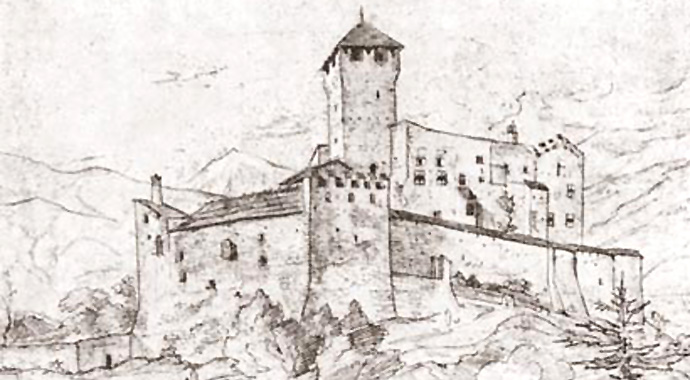
Historical drawing Churburg Castle
Romanesque Buildings
The oldest part of Churburg shows all the components of a typical medieval fortification. A circular wall with defense battlements encloses a spacious inner courtyard. On the mountain side there is a free-standing keep and on the south side a two-story hall built over a rectangular floor plan. Outside the circular walls, two additional buildings round off the overall picture: on the mountain side there is a small castle chapel in the Romanesque style (consecrated in 1334), on the other hand a foretower secures the way to the castle on the south side. The foretower, called Pfaffeneck, was destroyed in 1357 during a Matsch family feud. The reconstruction in its present form will only be completed in the first half of the 16th century.
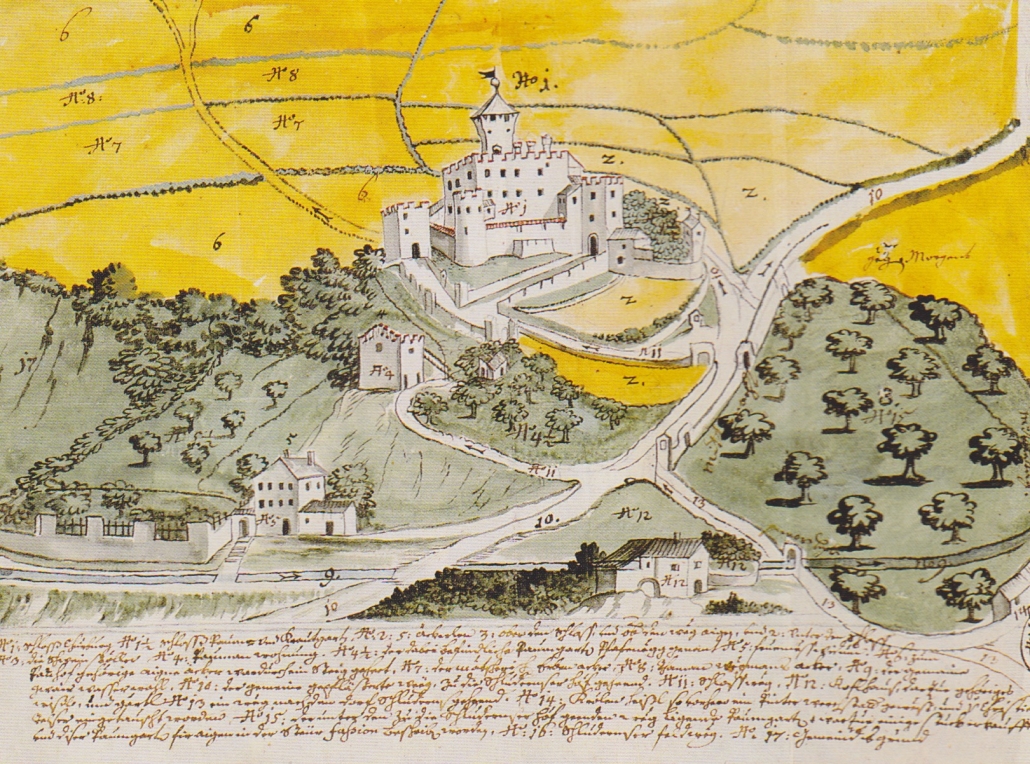
Historical drawing Churburg Castle and the surrounding estates
Gothic Buildings
The most formative renovations and extensions take place after Count Trapp receives possession of Churburg at the beginning of the 16th century. During this time, the castle more or less takes on its current dimensions and shape. The focus of the construction work is on expanding the defense facilities and modernizing the living space. The complex is surrounded by another defensive ring in addition to the historical complex in which there is space for an outer castle courtyard and a kennel complex. as well as the Romanesque castle chapel. The gate tower is to be built at the new south entrance of the castle and the bell tower, completed in 1537, will shape the appearance on the eastern flank. In the historical core of the castle, further residential buildings are added between the hall and the keep, which are grouped around a spacious inner courtyard. This inner courtyard is surrounded by an arcade on the first floor. The medieval hall is raised by a firewall and is provided with a crenellated wreath. Today’s three-terrace garden is being built, with the lowest terrace still being used as a tournament ground at that time.
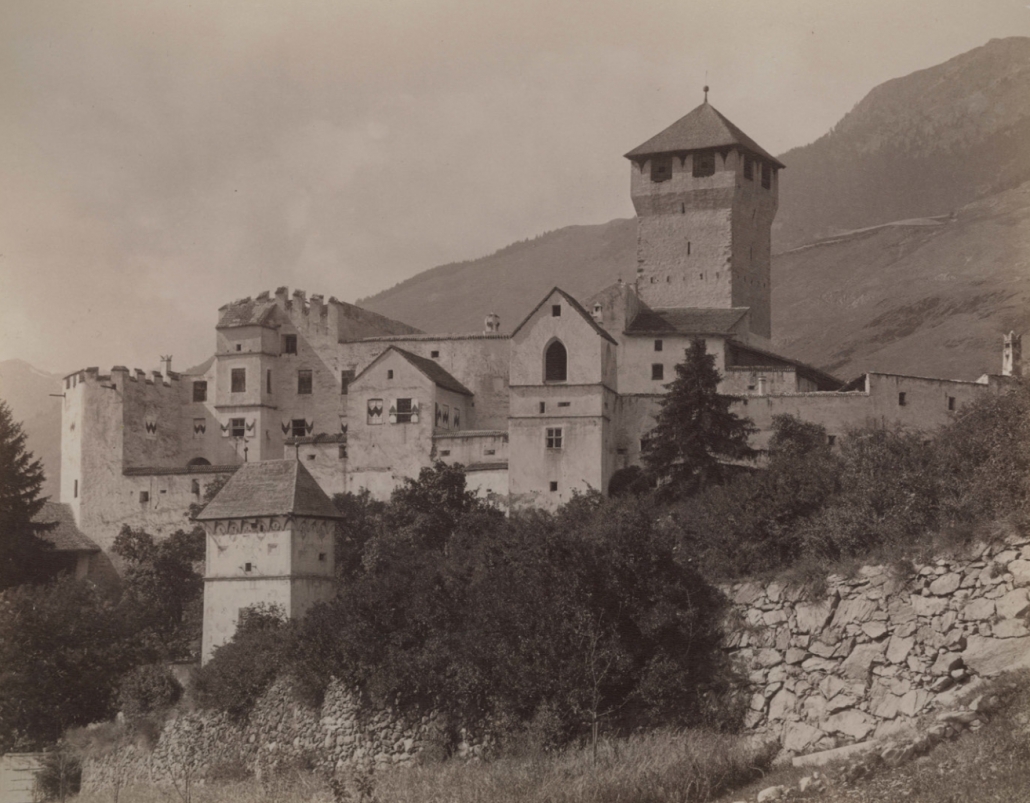
Historical image of Churburg Castle
Renaissance
In the second half of the 16th century, the complex is transformed into a splendid Renaissance castle. The focus is the elaborate decoration of a large number of rooms in the Renaissance style. The sculptured columns in the arcade are completed and the walls and ceiling are painted with colourful frescos. The Jakobszimmer is furnished with elaborate paintings and sophisticated ceiling decorations. The Jakobskapelle is built, after which the Romanesque castle chapel is desecrated. The premises of the old castle chapel will subsequently become part of a larger “functional” building complex that will be completed along the north and east sides of the outer ring wall. There is space here, among other things, for various stables, the feeding house (today’s armoury), grain and storage facilities as well as a bakery and smokehouse.
The substantial construction and expansion work on Churburg finally comes to an end in the 18th century. The hall will be raised by a full upper floor and expanded into a guest wing in the Baroque style. Paintings depicting biblical scenes and glazed tiled stoves are the main defining features of the new rooms. The “Matscher Saal” (today’s ancestral hall) is built and a new staircase connects the arcade with the upper floor and the “Matscher Saal”. Around 1800, a castellan’s apartment is built connecting the storage rooms and the bell tower on the eastern defensive wall.
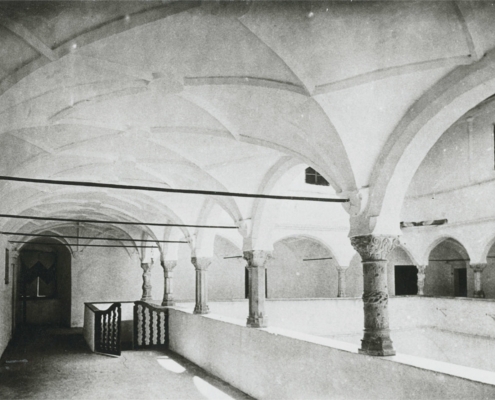
Arcades before the removal of the lime whitewash
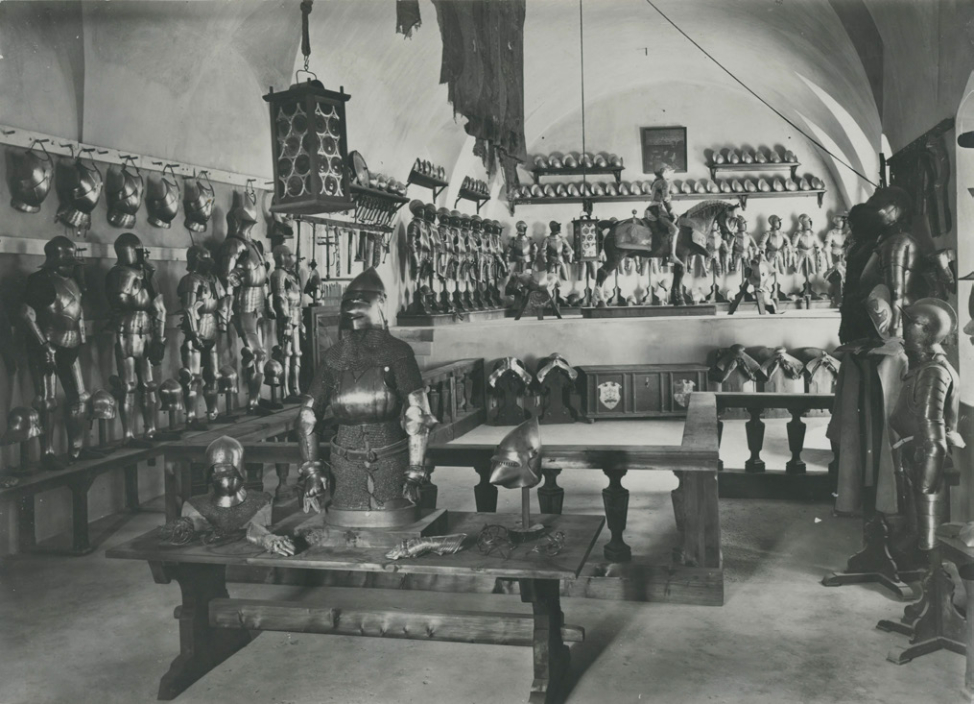
Churburg Armory in the first half of the 20th century
Count Gotthard Trapp In the tradition of their ancestors, the Trapp family has committed itself to the preservation and conservation of Churburg to the present day. Count Gotthard Trapp, the great-grandfather of today’s Count Gaudenz Trapp, continued this tradition by undertaking a number of projects at the end of the 19th and the beginning of the 20th century that are of great importance for the Churburg’s appearance today.
- 1889 Redesign of the large feed house into an armoury, as well as the first systematic list of armaments
- 1892 Removal of the pyramidal roof on the keep for fire protection reasons
- 1907 Painting and decoration of the walls and vaulted ceiling of the Jakob’s Chapel
- 1908 Removal of the 18th century lime whitewash which had covered the wall and ceiling frescos in the arcade.
Count Gotthard Trapp In the tradition of their ancestors, the Trapp family has committed itself to the preservation and conservation of Churburg to the present day. Count Gotthard Trapp, the great-grandfather of today’s Count Gaudenz Trapp, continued this tradition by undertaking a number of projects at the end of the 19th and the beginning of the 20th century that are of great importance for the Churburg’s appearance today.
- 1889 Redesign of the large feed house into an armoury, as well as the first systematic list of armaments
- 1892 Removal of the pyramidal roof on the keep for fire protection reasons
- 1907 Painting and decoration of the walls and vaulted ceiling of the Jakob’s Chapel
- 1908 Removal of the 18th century lime whitewash which had covered the wall and ceiling frescos in the arcade.
Arcades before the removal of the lime whitewash
Churburg Armory in the first half of the 20th century
